
2018 original survey · 29,963 members · Technology review updated October 2026
Sex robots and AI sex technology: our 2018 survey meets today’s reality
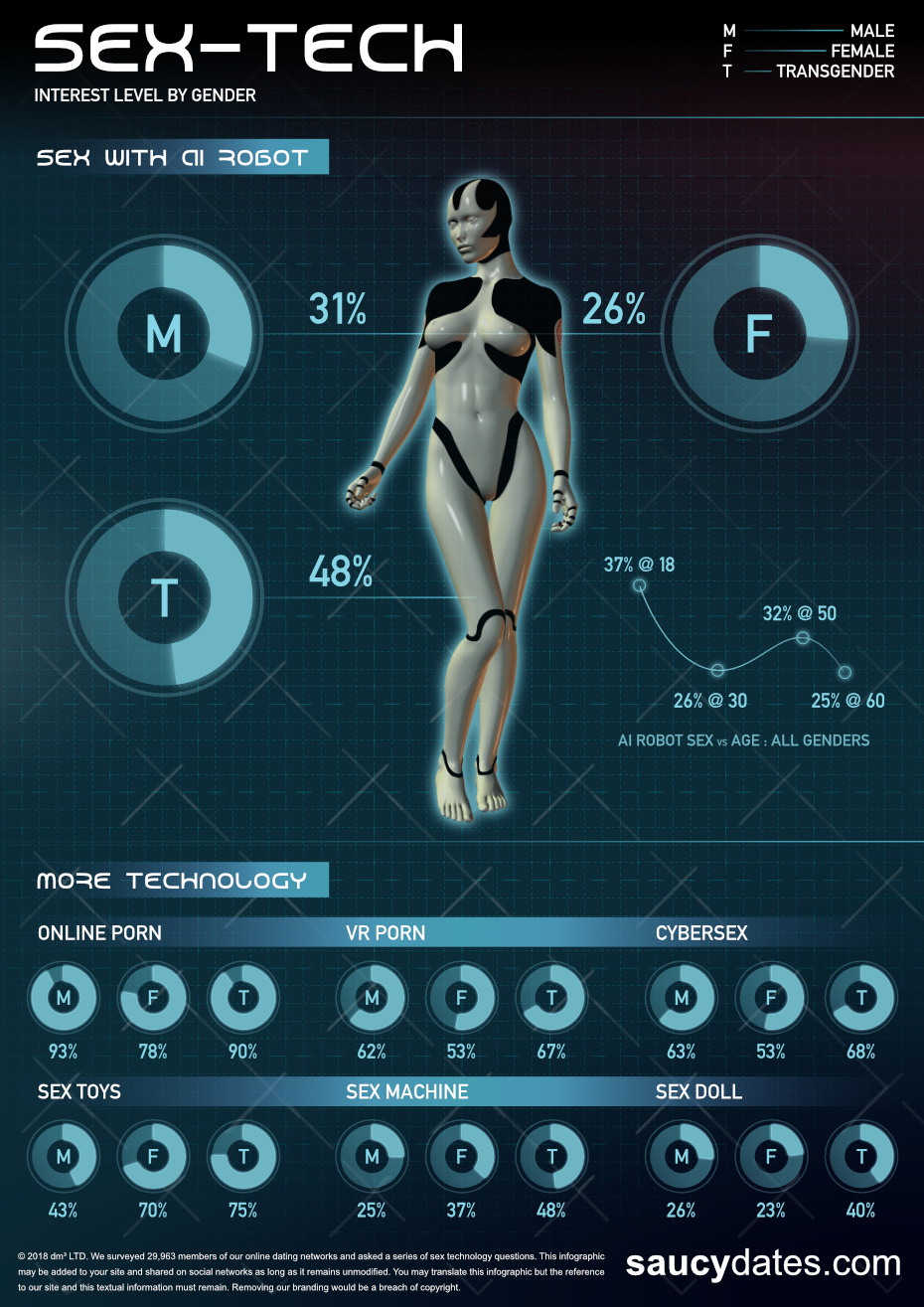
In 2018, Saucy Dates asked 29,963 members about sex technology, including whether they would have sex with an AI robot. 31% of male respondents, 26% of female respondents and 48% of the survey’s transgender group said yes. We were asking about an imagined future, not measuring widespread ownership of intelligent sex robots.
Eight years later, that question feels less remote. But sex dolls, connected devices, AI companions and physical robots are still different technologies. This report preserves our original data and infographic, compares later research and looks at what manufacturers actually describe today.
Was Saucy Dates ahead of the conversation? Our survey certainly explored interest before today’s generative AI companion boom. Did we cause the trend, and have people become more accepting? Those are different questions, and the evidence deserves a closer look.
The 2018 context · Original results · Infographic · Have views changed? · Technology today · Conclusions · FAQs
2018: before the AI sex robot imagined by the public
Our original question was explicitly future facing: “In the future, would you have sex with an artificial intelligence robot?” Respondents could imagine a level of intelligence, conversation and physical capability that a product might not actually provide.
It would be too strong to say sex robots did not exist at all. Early products and the public debate predated this survey: YouGov was already discussing the category in 2014. The more accurate context is that our 2018 research explored willingness towards future AI robots, rather than adoption of the sophisticated autonomous partners people might picture.
Was Saucy Dates pushing the trend?
We were contributing to the discussion by asking a large dating site audience about it and publishing the answers. Our distinctive contribution was to place the robot question alongside existing experiences of online content, cybersex, toys, dolls and machines. That made it possible to compare curiosity about the future with reported use of familiar technologies.
There is no evidence here that our survey caused manufacturers to develop products or changed public opinion. The defensible claim is that Saucy Dates documented an early audience response and anticipated questions that remain relevant today.
Sex robot, AI companion or connected toy: what is the difference?
| Category | What it describes | What it does not establish |
|---|---|---|
| Sex doll | A physical adult product, without necessarily having powered movement or conversational software. | A realistic appearance is not evidence of AI. |
| Sex machine or connected toy | A powered device; some support apps or remote control. | Automation does not necessarily mean intelligence or humanoid robotics. |
| AI companion | A software character offering conversation or simulated companionship. | A chatbot need not have a physical body. |
| Social humanoid robot | A physical robot designed for human interaction, potentially with speech, expressions or movement. | Humanlike looks do not make it a product designed for sex. |
| AI sex robot | A physical product intended for sexual use with robotic and AI functionality. | The label alone does not specify autonomy, mobility or verified capabilities. |
Our original sex technology survey: all 2018 results
We surveyed 29,963 Saucy Dates members about online pornography, virtual reality, cybersex, toys, dolls, hands free machines and future AI robots. The original categories were male, female and transgender, abbreviated M, F and T below. We retain those historical groupings; transgender identity can also overlap with being male or female.
| Question | Answer | M | F | T |
|---|---|---|---|---|
| Do you watch porn online? | No | 7% | 22% | 10% |
| Do you watch porn online? | Yes, often | 47% | 39% | 55% |
| Do you watch porn online? | Yes, sometimes | 46% | 39% | 35% |
| Have you ever had cybersex? | No | 37% | 47% | 32% |
| Have you ever had cybersex? | No, but I would like to | 33% | 21% | 23% |
| Have you ever had cybersex? | Yes | 30% | 32% | 45% |
| Have you ever had sex with a sex doll? | No | 74% | 77% | 60% |
| Have you ever had sex with a sex doll? | No, but I would like to try | 21% | 15% | 25% |
| Have you ever had sex with a sex doll? | Yes | 5% | 9% | 15% |
| Have you ever had sex with a sex machine? | No | 75% | 63% | 52% |
| Have you ever had sex with a sex machine? | No, but I would like to try | 20% | 24% | 32% |
| Have you ever had sex with a sex machine? | Yes | 6% | 13% | 16% |
| Have you ever watched VR porn | No but I would like to | 43% | 38% | 39% |
| Have you ever watched VR porn | No, not interested | 38% | 47% | 33% |
| Have you ever watched VR porn | Yes | 20% | 15% | 28% |
| Have you used a sex toy on yourself? | No but I would like to | 21% | 16% | 18% |
| Have you used a sex toy on yourself? | No, not interested | 57% | 30% | 25% |
| Have you used a sex toy on yourself? | Yes | 22% | 54% | 58% |
| Would you have sex with an AI robot? | No | 69% | 74% | 52% |
| Would you have sex with an AI robot? | Yes | 31% | 26% | 48% |
These are the original published percentages. The survey’s graphic combined use and interest for several categories, whereas this table keeps them separate. Some rounded groups total 101%; the original values have not been altered. Subgroup counts and detailed sampling information are not supplied in the original article.
The original 2018 sex technology infographic
Embed the original infographic
Please retain the 2018 context, credit Saucy Dates and link to this report.
What the 2018 figures revealed about robot sex technology
Robots attracted more interest than dolls
The AI robot answers were 31%, 26% and 48% across M, F and T. Adding existing doll use to interest in trying a doll gives 26%, 24% and 40%. The robot figures were therefore higher by five, two and eight percentage points respectively.
That supports our original observation that the idea of an intelligent robot could appeal beyond the doll category. It does not isolate whether intelligence, movement, novelty or a different imagined experience caused the difference: respondents did not evaluate otherwise identical products in an experiment.
Interest was often well ahead of experience
For VR pornography, 43% of men, 38% of women and 39% of the transgender group had not tried it but wanted to, compared with 20%, 15% and 28% who had. There was a clear curiosity experience gap in each group.
For dolls, reported use was only 5%, 9% and 15%, while another 21%, 15% and 25% wanted to try them. These differences remind us why an interested audience cannot be treated as a count of customers.
Established technologies had very different audiences
Reported toy use was 22% among men, 54% among women and 58% in the transgender group. Cybersex experience was 30%, 32% and 45%. Online pornography use, combining “often” and “sometimes”, was 93%, 78% and 90%.
There was no single pattern that applied to every technology. The transgender group had the highest AI robot interest and several other results in this sample, but the missing subgroup counts prevent confident comparisons of statistical precision.
Age suggested another question worth revisiting
The original report described the highest AI robot interest at age 18, with a secondary increase in middle age. Without a full age table and subgroup counts, that remains a descriptive observation from the original analysis, rather than proof that age causes acceptance.
Try Saucy Dates · Adults 18+
Prefer a human connection?
Explore Saucy Dates for adults interested in shared attraction and casual dating.
Joining, browsing, Hots and flirts are free. Full private messaging requires an upgrade.
Have people’s views on sex robots changed since 2018?
There is evidence of increased willingness in some later polling, but not a continuous global trend we can calculate from our survey. Different populations, questions and technologies must be kept separate.
2020: evidence of increased willingness in a repeated question
YouGov’s 2020 US research reported that 22% would consider sex with a robot, six percentage points above its 2017 result. It surveyed 1,206 US adults on 26 to 27 February 2020. YouGov reported increases among both men and women.
This is useful evidence of change within YouGov’s own research series. It is not a follow up of Saucy Dates members, and its “would consider” wording is not identical to our future facing question.
2025: AI companions still met considerable hesitation
YouGov’s August 2025 British research found 14% comfortable to some degree with a long term AI companion connection, while 75% were uncomfortable. Data privacy and security was a concern for 65%.
That concerns a long term connection with software companions, not specifically sex with a physical robot. It shows why increased visibility should not be mistaken for broad acceptance, but cannot tell us whether the 2018 robot percentages have risen or fallen.
2025: research moved beyond one yes or no question
A 2025 study by Balazadeh and Kajonius developed the Robot Intimacy Receptivity Scale using two samples totalling 572 participants. It distinguished communication, social distance and personal intimacy.
This is a newer research tool, not a replacement edition of our survey or a measure of consumer ownership. Its relevance is the distinction between being willing to speak to a robot and welcoming a more intimate relationship with one.
2018 versus later research: what can be compared?
| Research | Population and topic | Meaning for this story |
|---|---|---|
| Saucy Dates, 2018 | 29,963 members; existing sex technology use and hypothetical AI robot interest. | Our original historical benchmark, not a national population estimate. |
| YouGov, 2017 to 2020 | US attitudes to considering sex with a robot. | Evidence of change within a separate polling series. |
| YouGov, 2025 | British attitudes towards AI companions. | A related but different question about connection and comfort. |
| RIRS study, 2025 | Development of a measure of receptivity to robot intimacy. | A framework for asking more precise questions in future research. |
To establish change among Saucy Dates members, we would need to repeat the original questions with a comparable sample and report the sampling differences. No new Saucy Dates survey is being presented here.
What is the reality of sex technology in 2026?
Today’s picture is a collection of different products and capabilities. A convincing conversation, remote device control and a mobile robotic body are separate achievements. The examples below are documented products or announcements, not hands on reviews or endorsements.
Connected devices: a concrete development of the original theme
Lovense’s official documentation describes internet based partner control through its app, with a request accepted by the other person. This is a current example of the remote interaction discussed in our original article. It connects people through a device; it does not make the device an autonomous partner.
Humanoid robots: conversation and embodiment
Realbotix’s current product catalogue describes a conversational robotic bust starting at $20,000 and a modular model stationary from the waist down. This is useful evidence of actual product categories, costs and movement limits. Its companionship positioning should not be taken as proof of sexual functionality.
2026 demonstrations: what was actually shown?
In its CES 2026 announcement, Realbotix reported an unscripted conversation between its Aria and David robots, alongside a separate vision system demonstration. These are manufacturer reported developments in conversation and interaction, not demonstrations of an autonomous sexual relationship or evidence of mass adoption.
The missing leap: from capability to everyday adoption
The sources reviewed do not establish that fully autonomous sex robots have become ordinary household products. Product pages show what companies offer or claim; they do not provide a representative measure of use. An AI label should prompt questions about the exact hardware, software, movement and reliance on remote services.
Our interpretation is that the future has arrived in parts: connected devices, software companions and conversational robotics. The all in one robot imagined by a survey respondent is a much larger claim than any one of those capabilities.
Privacy matters as much as realism
Sex technology may involve intimate messages, account details or device connections. Before using a service, understand what is stored, who can access it, how deletion works and whether it relies on a continuing cloud subscription. A lifelike response does not make a system private.
Our longstanding advice is to separate intimate accounts from work and identifying social profiles wherever possible. See our online dating privacy guide. With partners, agree what sharing, recording and device access each person is comfortable with.
What did Saucy Dates get right, and what remains unproven?
- Interest preceded experience. The 2018 data recorded curiosity about several technologies that respondents had never used.
- The robot question reached beyond dolls. Robot interest was higher than doll use plus interest in each original group, though we cannot establish the reason.
- Technology and intimacy remained connected topics. Later research and current product documentation show continued development, even where the form differs from the original imagined robot.
- Acceptance is not guaranteed by better technology. Later companion research still identifies substantial discomfort and privacy concerns.
- Our contribution was evidence and discussion. We can document the early survey, but not claim that it drove the industry or forecast a particular product’s success.
Voices from the 2018 survey
The original comments capture how respondents talked about the technology at the time. They are individual accounts, not current product reviews or representative explanations for an entire group.
Read the original participant comments
I love watching porn with my partner, then acting it out and doing role play. We even make our own porn and love to watch them back together.
I’m very horny and unattractive. Technology and porn is my only hope.
VR porn + vibrating strap on = magic
I used to go to chatrooms and have virtual sex with random men all the time. I met my last partner from a sex chat.
I think remote sexual aids are very erotic and find the thought of someone wanting to use this type of play or stimulation with me very arousing.
Thank god for vibrators and rechargeable batteries.
Sex toys and sex machines are the greatest invention ever made.
Hated the plastic inflatable woman. Don't know enough about the new dolls.
I love the way the female doll feels, like real!
Futuristic Sex Doll and Sex Machine could be fun.
Eliminate relationships and still have good sex. Hmm.
I love technology and I hope one day I'll have a sex robot.
Looking forward to sex robots.
Sex robots are an interesting way to explore group sex for couples who don't actually want to engage with other people.
Methodology and historical context
The 2018 Saucy Dates survey involved 29,963 members. It asked about online pornography, VR pornography, toys, cybersex, dolls, hands free machines and future AI robot interest, with an invitation to comment. Responses varied by question: the complete table shows the actual options, including “often” and “sometimes” for online content.
For several infographic categories, use and willingness to try were combined as interest. That must not be described as adoption. The AI robot question asked about a future possibility, not an existing experience.
The original article does not supply exact fieldwork dates within 2018, subgroup counts, weighting or a representative sampling method. Original percentages and the graphic remain unchanged. This October 2026 update adds interpretation and independently linked sources, without presenting the original data as newly collected.
Sex robots and AI sex tech: frequently asked questions
Did sex robots exist in 2018?
Early products and discussion already existed. Our survey concerned willingness towards future AI robots, rather than widespread ownership of sophisticated autonomous partners. Saying no sex robots existed at all would overstate the historical context.
How many respondents were interested in AI robot sex?
In the original survey, 31% of male respondents, 26% of female respondents and 48% of the transgender group answered yes. These are separate group results; the article does not provide the group sizes needed to calculate a combined percentage.
Have attitudes become more positive?
YouGov found greater willingness in its 2020 US robot sex polling than in 2017. Later research on AI companions asked a different question and still found substantial hesitation. There is no like for like Saucy Dates follow up here.
Is an AI companion the same as a sex robot?
No. A companion may be entirely software. A physical robot adds hardware, while a connected toy may simply allow remote control. The terms describe different capabilities.
Did Saucy Dates predict the trend?
Our 2018 research documented interest in a future facing category and compared it with existing sex technology. That makes it an early contribution to the conversation, not evidence that we caused the trend.
Can journalists use the original survey?
Yes. Please credit Saucy Dates, include the 2018 date and sample of 29,963 members, and link to this report. Distinguish hypothetical interest from actual use.
Share the research or discuss a new survey
Technology is one part of the wider conversation about intimacy. Compare this attitudes survey with our research into sexual duration and expectations and relationship interests by age, each based on a separate dataset.
For media enquiries or to discuss fresh research comparing today’s attitudes with the original questions, contact us or visit our press kit.
Explore our wearable dating technology concept, AI scam prevention article and more research on the Saucy Dates blog.