
Original Saucy Dates research · 45,526 respondents
Men vs women in relationships: who lies and cheats more?
Our international survey of 45,526 people found no simple answer to who deceives more in relationships. Men reported higher rates of cheating, profile lies, thinking about someone else during sex and saying “I love you” without meaning it. Women reported higher rates of faking orgasms, avoiding dates with an invented excuse and ending relationships by text or email.
Those headline differences tell only part of the story. Country results sometimes reversed the international pattern, and respondents’ comments revealed very different reasons behind apparently similar answers: privacy, avoiding embarrassment, sparing feelings, dissatisfaction and deliberate deception.
The original message remains direct: what people admit about dating and relationships can be surprising. Explore the figures, the James and Jessica comic and the comments behind the percentages, then use the findings to encourage more honest conversations with your partner.
Key findings · Original comic · Country data · Cheating · Conclusions · Methodology · FAQs
Seven relationship questions: the international results
Each percentage below is the published share answering yes to an “ever” question. It measures whether respondents reported having done something, not how regularly they did it, whether it happened in their current relationship or whether they still do it.
| Survey question | Men | Women | Difference |
|---|---|---|---|
| Faked an orgasm | 17% | 31% | Women 14 percentage points higher |
| Ended a relationship by text / email | 20% | 32% | Women 12 percentage points higher |
| Used a made up excuse to avoid a date | 33% | 41% | Women 8 percentage points higher |
| Thought about someone else during sex | 53% | 47% | Men 6 percentage points higher |
| Lied on a dating profile | 19% | 16% | Men 3 percentage points higher |
| Cheated on a partner | 31% | 27% | Men 4 percentage points higher |
| Said “I love you” without meaning it | 36% | 29% | Men 7 percentage points higher |
Differences are calculated from the original published percentages. A percentage point gap is a subtraction: for example, 31% minus 17% is 14 percentage points. It is not a 14% relative increase.
Largest gender gap
Faking an orgasm: 31% of women versus 17% of men, a 14 point difference internationally.
Smallest gender gap
Dating profile lies: 19% of men versus 16% of women, a three point difference.
Cheating was closer
31% of men versus 27% of women reported cheating, a four point difference.
James and Jessica: the relationship survey comic
Our original comic brings the survey themes together in the story of James and Jessica. It is an illustration inspired by the research, not a case history of two actual respondents or a claim that all these behaviours occur together in one relationship.
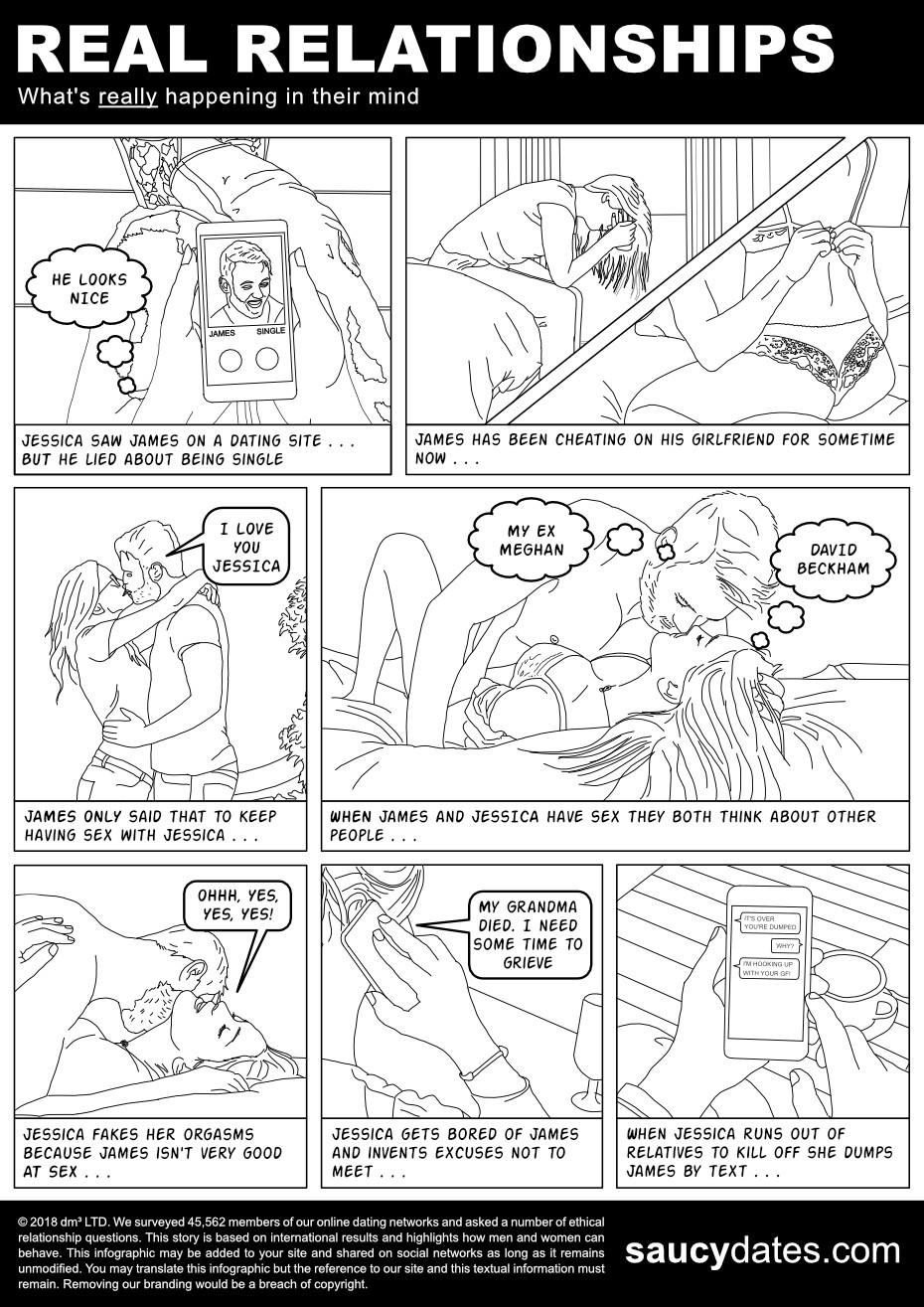
Embed the relationship comic on your website
Please credit Saucy Dates and link to this article for the full results.
Men and women in relationships: results by country
The full published table shows nine countries alongside the international results. Other countries also contributed to the international figures, so that final row should not be treated as a simple average of the nine countries shown.
| Country group | Faked orgasm | Dumped via text | Avoided dates | Thought of someone else | Lied on profile | Cheated | Said I love you | |||||||
|---|---|---|---|---|---|---|---|---|---|---|---|---|---|---|
| Country | M | F | M | F | M | F | M | F | M | F | M | F | M | F |
| United States | 17% | 30% | 18% | 30% | 35% | 39% | 57% | 46% | 18% | 13% | 35% | 26% | 37% | 25% |
| United Kingdom | 15% | 47% | 15% | 30% | 31% | 50% | 56% | 58% | 17% | 19% | 35% | 36% | 34% | 36% |
| Canada | 16% | 33% | 18% | 35% | 36% | 48% | 54% | 51% | 20% | 18% | 29% | 31% | 35% | 33% |
| India | 18% | 27% | 24% | 31% | 24% | 43% | 40% | 51% | 18% | 28% | 16% | 35% | 33% | 47% |
| South Africa | 18% | 38% | 22% | 20% | 38% | 57% | 54% | 53% | 16% | 14% | 39% | 32% | 40% | 33% |
| Australia | 17% | 49% | 13% | 39% | 30% | 46% | 52% | 65% | 21% | 29% | 30% | 39% | 29% | 36% |
| Germany | 21% | 19% | 24% | 38% | 28% | 30% | 48% | 32% | 25% | 11% | 26% | 18% | 32% | 11% |
| Netherlands | 12% | 11% | 18% | 30% | 32% | 29% | 50% | 33% | 21% | 6% | 29% | 11% | 33% | 11% |
| France | 23% | 23% | 23% | 51% | 33% | 37% | 50% | 38% | 20% | 26% | 30% | 27% | 34% | 24% |
| International | 17% | 31% | 20% | 32% | 33% | 41% | 53% | 47% | 19% | 16% | 31% | 27% | 36% | 29% |
All values reproduce the original results table. M = men; F = women. “Dumped via text” covers text / email; “Said I love you” means saying it without meaning it. Country and gender subgroup sizes are not provided in the original article.
Made up excuses to avoid a date: 41% of women, 33% of men
Women reported inventing an excuse more often than men internationally, an eight point gap. The same direction appeared in eight of the nine country comparisons. The exception was the Netherlands, where 32% of men and 29% of women answered yes.
Among the countries shown, South African women reported the highest female result at 57%, followed by British women at 50% and Canadian women at 48%. Indian men had the lowest male figure at 24%, while Dutch women had the lowest female figure at 29%.
The original comments named familiar everyday explanations. A claimed illness or work problem is not proof of a lie: these lists concern occasions respondents themselves described as invented.
Excuses reported by women
- A death in the family or a family event
- Illness or a severe headache
- Being unable to find a babysitter
- Being tired
- A work related issue
Excuses reported by men
- A car accident or repair
- A work related issue
- A burst pipe or home repair
- An invented birthday or family event
- Illness
The finding is about avoiding an uncomfortable conversation as much as avoiding a date. The survey did not quantify motives, so it cannot tell us how often fear of a reaction, politeness or simple disinterest lay behind an excuse.
Read original participant comments
Breaking up by text or email: 32% of women, 20% of men
This was the second largest international gender gap, at 12 percentage points. Women reported ending a relationship this way more often in eight of the nine countries. South Africa was the exception: 22% of men versus 20% of women.
French women had the highest female figure at 51%, compared with 23% of French men. That 28 point gap was the largest country level difference for this question. Australian women and men followed with a 26 point gap, at 39% and 13% respectively.
The data identifies the method used, not the length of the relationship or the reason for choosing it. A text breakup and cheating are different behaviours; a yes answer here does not automatically establish dishonesty. The original comments show that the wording and circumstances could matter as much as the medium.
Read original participant comments
Try Saucy Dates · Adults 18+
Be upfront about what you want
Explore a dating community where you can share your interests and look for a compatible connection.
Joining, browsing, Hots and flirts are free. Full private messaging requires an upgrade.
Lying on a dating profile: a minority in both groups
The international results were 19% of men and 16% of women. This was the smallest of the seven gender gaps. Most respondents in both groups did not report lying on their profile.
Among the countries shown, male figures ranged from 16% in South Africa to 25% in Germany; female figures ranged from 6% in the Netherlands to 29% in Australia. Women reported higher rates than men in the UK, India, Australia and France, reversing the international direction.
Privacy is different from misleading a potential partner
Some respondents described using another name or withholding their exact location for safety. That distinction is central to our original message: protecting identifying information is different from deceiving someone about relationship status or intentions.
At Saucy Dates, we recommend a pseudonym and a separate email address that does not expose work or personal information. Our online dating privacy guide explains this approach in more detail.
What did the other profile accounts describe?
The original comments also included claims about age, height, weight, wealth and relationship status. Some attached respondents said they disclosed their status; others described concealing it. These comments illustrate different kinds of answers, but do not establish a numerical breakdown of each type of lie or a rule for all men or women.
Read original participant comments
Faking an orgasm: the largest international difference
31% of women and 17% of men reported having faked an orgasm. The 14 point gap was larger than the difference for any other question. However, the country breakdown shows that the international pattern was not universal.
Women reported higher rates in six countries, men in Germany and the Netherlands, and both groups were equal in France at 23%. The largest gaps were in Australia, at 49% of women versus 17% of men, and the UK, at 47% versus 15%: 32 points in each case.
The original comments from both groups included wanting an encounter to end and not wanting to hurt a partner’s feelings. Some men also mentioned pressure to finish; some women described trying to encourage a partner or avoid embarrassment. These are reported explanations, not proven causes or a measure of how often each motive occurred.
The practical message is about communication, rather than performance. The survey provides no way to diagnose a partner’s experience from their behaviour. Our sex talk survey explores another side of that conversation.
Read original participant comments
Who cheats more: men or women?
Men reported cheating more often internationally: 31% versus 27% of women. The difference was four percentage points, smaller than the gaps for faking an orgasm, text breakups or invented date excuses. Neither group was overwhelmingly more likely to report cheating in the combined results.
The country comparisons tell a more varied story. Women reported higher rates in the UK, Canada, India and Australia; men reported higher rates in the US, South Africa, Germany, the Netherlands and France.
The largest country differences in cheating
- India: 35% of women versus 16% of men, a 19 point gap.
- The Netherlands: 29% of men versus 11% of women, an 18 point gap in the opposite direction.
- The UK: 36% of women versus 35% of men, only a one point gap.
- Canada: 31% of women versus 29% of men, a two point gap.
South African men and Australian women each had the highest figure for their respective gender among the countries listed, at 39%.
Respondents’ comments mentioned dissatisfaction, a perceived lack of attention and retaliation after discovering a partner’s cheating. Those explanations do not excuse the behaviour or prove what causes cheating. The survey did not match couples, so similar overall rates cannot show that people who cheat tend to partner with each other.
Read original participant comments
For another perspective, see our survey about ending a relationship or forgiving after cheating.
Thinking about someone else during sex: common, but not the same as cheating
The international table records 53% of men and 47% of women. It was the most frequently reported answer among both groups across the seven questions.
Among women in the countries listed, Australia had the highest figure at 65%, followed by the UK at 58%. Among men, the US led at 57%, followed by the UK at 56%. Women reported higher rates than men in the UK, India and Australia.
The original comments mentioned former partners, celebrities, colleagues and other people respondents found attractive. They show a range of thoughts, rather than evidence that everyone imagines the same type of person. Nor does a private thought establish an intention to act on it.
This distinction matters to the article’s larger question. If seven very different behaviours are grouped under “deception”, readers can miss the difference between a thought, an awkward conversation and a breach of an agreed relationship boundary.
Read original participant comments
Saying “I love you” without meaning it
36% of men and 29% of women said they had done this: a seven point gap internationally. Men reported higher rates in six of the nine countries; women reported higher rates in the UK, India and Australia.
The Netherlands had the largest gap, at 33% of men versus 11% of women, followed by Germany at 32% versus 11%. Indian women recorded the highest female figure at 47%, and South African men the highest male figure at 40%, among the countries shown.
The original comments described wanting to avoid hurting someone, feeling pressured to reciprocate, confusion about feelings and, in some cases, personal advantage. The survey did not count these motivations separately. Its useful message is that the same phrase can conceal very different intentions, and an apparently kind reassurance can still leave another person with a misleading understanding of a relationship.
Read original participant comments
Six conclusions from the relationship survey
- There is no single gender wide answer to “who deceives most”. Men had higher international percentages in four categories and women in three. Counting categories does not measure the seriousness or total frequency of someone’s behaviour.
- The largest gaps were not for cheating. Faking an orgasm differed by 14 points and text breakups by 12; cheating differed by four.
- Country results can reverse the headline. India’s cheating comparison and the Netherlands’ date excuse comparison went against the international direction. Broad averages can hide local variation in the sample.
- UK and Australian women had higher figures in all seven categories than men in their respective samples. This is a descriptive pattern in the published table, not a verdict on individuals from either country.
- Privacy and deception should not be treated as identical. Profile answers included protective use of another name as well as potentially misleading claims about a person’s circumstances.
- Context changes the meaning of a yes answer. Thinking about someone else, ending a relationship by message and cheating are not interchangeable acts. Honest communication is more useful than treating all seven as one moral score.
The original “gender awards”
The original article included the following tongue in cheek country awards. They are retained as part of the original story, rather than presented as a validated measure of national character or ethics. The article did not publish a scoring method, so these rankings should not be used to predict an individual’s honesty.
View the original country awards
Least ethical women:- 1st Australia
- 2nd United Kingdom
- 3rd India
- 1st South Africa
- 2nd France
- 3rd Canada
- 1st Netherlands
- 2nd Germany
- 3rd United States
- 1st India
- 2nd Australia
- 3rd Netherlands
Survey methodology: what 45,526 responses can tell us
Our original international survey asked 45,526 people seven questions about their relationship experiences: whether they had ever ended a relationship by text or email, invented an excuse to avoid a date, cheated, faked an orgasm, lied on a dating profile, said they loved someone when they did not, or thought about someone else during sex.
The table gives the published percentages answering yes, separated into men and women. The international results include countries beyond the nine shown. This expanded article retains the original table and comic; the additional comparisons are calculations from those published percentages, not new fieldwork.
The original report does not supply fieldwork dates, country and gender subgroup counts, age distributions, response rates or a weighting method. A large total sample does not by itself make every country comparison representative. Without subgroup counts and the survey design, we cannot establish statistical significance or attach margins of error to the differences.
Answers are self reported and concern whether something had ever happened. They do not measure current behaviour, frequency or the reasons for every answer. We also cannot add the percentages to work out how many people had done any one of these things, because the same person may have answered yes to several questions.
Questions about men, women and relationship honesty
Who cheated more in this survey?
Internationally, 31% of men and 27% of women reported having cheated. The direction varied by country: women reported higher rates in the UK, Canada, India and Australia.
Who lied more on dating profiles?
The international table reports 19% of men and 16% of women. Some comments concerned privacy measures, such as using another name, rather than misleading a partner about relationship intentions.
What was the biggest difference between men and women?
Internationally, faking an orgasm showed the largest gap: 31% of women versus 17% of men, a difference of 14 percentage points.
Was thinking about someone else the most common answer?
Yes. At 53% of men and 47% of women, it was the highest international percentage for each group among the seven questions. It should not be equated with acting on a thought or cheating.
Can the survey tell me whether my partner is lying?
No. Group level results cannot reveal what one person has done or what they mean. The findings can prompt a discussion, but they are not a test of an individual’s honesty.
Are these new relationship statistics?
No. These are the original Saucy Dates findings, now presented with fuller explanation and comparisons. The article update does not represent a new survey.
Share or cite the relationship survey
Please credit Saucy Dates’ international survey of 45,526 people and link to this page when using the figures or comic. Include the exact question and population being compared: for example, “31% of male respondents said they had ever cheated”, rather than a claim about all men.
Keep country results tied to the country sample and describe differences as percentage points. For press enquiries or to discuss commissioning a new survey, contact us or visit our press kit.
What should couples take from the findings?
For a different perspective on what people want, explore the sex and relationships report by age. Our survey of penis size claims and estimates also shows why the wording of a question matters when interpreting personal reports.
We hope your relationship does not resemble James and Jessica’s story. The lasting point of the research is that the answers people give in private can differ from what a partner assumes. Motives and circumstances matter, and the seven questions reveal several different forms of that gap.
Our best advice remains to talk openly: about expectations, exclusivity, privacy, feelings and what each person needs from the relationship. The figures offer conversation starters, not a reason to judge a partner by their gender or nationality. Explore more original research on the Saucy Dates blog.