
Dating safety · AI assisted scam detection
How LLM AI helps detect scammers in dating chats
A convincing profile can start a conversation, but the conversation itself may reveal a scam. Requests for money, pressure to follow a payment link or threats involving private images can emerge only after someone has begun to build trust.
Saucy Dates uses large language model (LLM) AI to help check chat for signs of scams. The purpose is to identify concerning patterns in what is being said, alongside other safety measures. AI can help recognise risk; it cannot guarantee that a person is genuine or that every scam will be detected.
How LLM checks work · Scam patterns · Chat privacy · Limits of AI · FAQs
What is an LLM, and why use one to check messages?
A large language model is an AI system trained to process language. In scam detection, it can help assess what a message appears to be asking someone to do and whether the language resembles a harmful pattern. That is more flexible than looking only for a fixed list of suspicious words.
For example, mentioning money is not automatically a scam. Discussing the cost of dinner is different from pressuring a new match to send money urgently. Context can make a difference: a request, the explanation around it and the pressure applied may matter more than any single word.
Where conversation context is provided, an LLM can consider how messages relate to each other. It can still misinterpret jokes, quotations or an innocent discussion. A concerning assessment is a signal to handle carefully, not proof of criminal intent.
From keywords to the meaning of a request
A keyword alone
“I bought a gift card for my sister.” This mentions a payment product without asking the other person to buy or send anything.
A request that deserves attention
A new match insists that you buy a gift card and send its code before they can continue talking. The request and pressure are the important parts.
These are illustrative examples, not actual member messages or a demonstration of a guaranteed detection result. Scammers can change their wording, so prevention needs more than a single phrase list.
What happens when a chat is flagged?
Saucy Dates uses both human review and automatic account restrictions in response to suspected scam activity. LLM analysis can help bring concerning conversations to the moderation team’s attention, while automated action can restrict accounts where the system identifies sufficient concern.
A flag is not proof of fraud, and automatic decisions can be wrong. Human review provides a way to examine the relevant context. If you believe your account has been restricted incorrectly, contact support and explain the issue.
Not every concern leads to the same action. We do not publish detection thresholds or bypass details, and no outcome is guaranteed from a particular phrase.
Scam patterns that chat analysis can help identify
Romance scams and urgent money requests
A conversation develops emotional closeness, then introduces a crisis that supposedly requires the other person’s money. Urgency, secrecy and repeated pressure can make the request more concerning.
Gift cards and payment codes
Someone asks a match to buy a card, send its code or pay a fee to keep communicating. A plausible explanation does not make handing over a payment code safe.
External payment and verification traps
A member is directed to a separate page and told to enter card details or pay to prove their identity. Access genuine service checks through the platform itself rather than a stranger’s link.
Booking and travel impersonation
A conversation about meeting leads to demands for booking details or a supposed payment problem. Contact a hotel or travel provider independently if someone unexpectedly asks for payment information.
Intimate image threats
Someone pressures a person for private material or threatens to share it. Threatening language and demands are reasons to stop contact and report the account.
Pressure to leave the service
Moving a conversation elsewhere is not automatically fraudulent. Persistent pressure combined with suspicious links, payments or evasion can be more concerning than simply asking to exchange contact details.
Try Saucy Dates · Adults 18+
Explore a service that takes scams seriously
Saucy Dates combines liveness checks, AI chat checks and human review to help tackle suspicious accounts.
Joining, browsing, Hots and flirts are free. Full private messaging requires an upgrade.
Why a profile or IP address is not enough
A name, photograph or apparent location can look plausible while the person’s requests reveal a different story. IP addresses can change or represent shared networks and VPN connections. They are not reliable proof of someone’s identity or actual location on their own.
Chat checks add another source of information: behaviour expressed in messages. Liveness checks during signup, member reports and blocking also have roles in the broader safety approach. No single signal should be treated as a guarantee of honesty.
Our dating scammer research article explains why familiar names and technical clues need context, while our fake profile guide covers practical warning signs.
What AI chat checks mean for privacy
Private messaging means a conversation is not a public post. It does not mean the service cannot process messages for safety. Our privacy documentation explains that messages may be analysed using automated systems to detect fraud, scams, abuse and other harmful activity.
This article explains the purpose of LLM checks; it is not a promise that every message is checked immediately, nor a specification of the model, processing provider or retention arrangements. Refer to the privacy documentation for data handling details, and contact us if you need clarification.
Do not put passwords, login codes, payment card details or identity documents into a conversation with another member. Learn more about separating your identity and controlling disclosure in our online dating privacy guide.
What AI cannot reliably tell you
An LLM does not know a stranger’s true identity or intentions simply because it has read their words. It can miss a scam, flag an innocent exchange or provide a convincing explanation that is wrong. NIST’s Generative AI Profile identifies unreliable or fabricated outputs as a risk of generative AI.
Scam detection is also different from detecting AI written text. A person can write a scam manually, and a genuine member might use writing assistance. The concern is harmful behaviour, not whether a message sounds polished or uses unusual grammar.
Do not interpret the absence of a warning as approval to send money, follow a link or share private material. Your own boundaries and reports still matter.
Scarlet: the earlier AI safety approach
Our original article introduced Scarlet, an AI assistant intended to support scam awareness and moderation. The historical screenshots below show that earlier interface. They illustrate the development of our approach rather than the appearance or exact operation of today’s LLM checks.
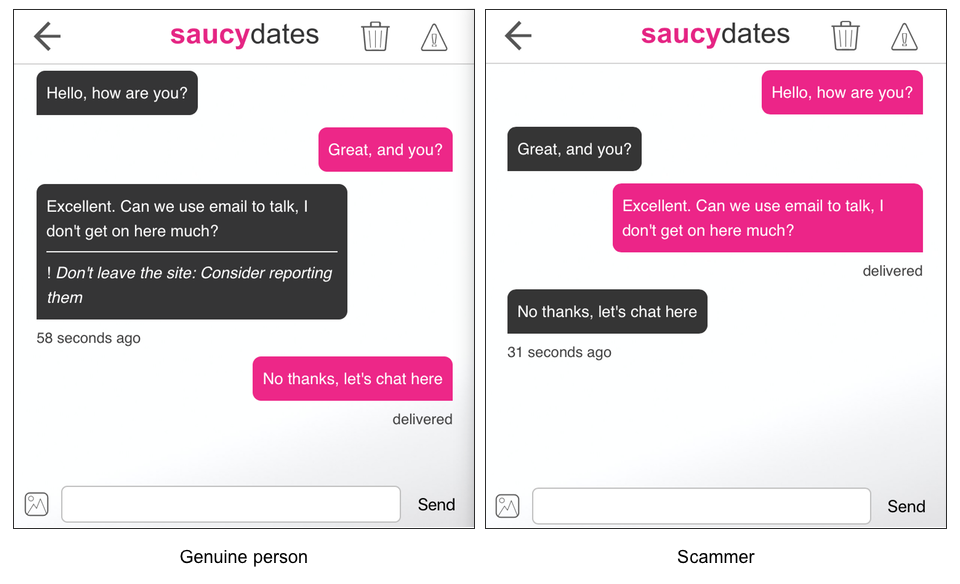
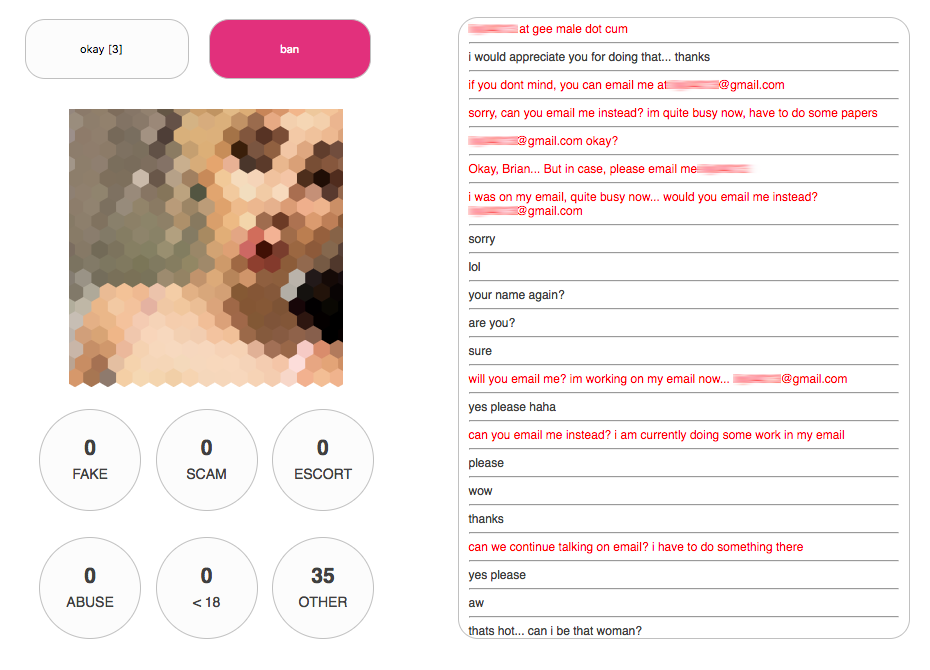
The aim remains to use information from conversations to help tackle fraud. This update does not present the original article’s historical success rate as a measured result for the current LLM system.
What to do when a conversation feels wrong
- Pause. Do not let urgency push you into a payment or sharing personal information.
- Report the account. Explain what concerned you and include relevant details through the service’s reporting process.
- Use blocking controls. You do not need to keep talking to establish whether someone is a scammer.
- Keep relevant evidence. Save messages or payment references if needed for a report, without publishing another person’s private information.
Read our dating safety guide for further precautions. AI adds a layer of detection; it does not replace your ability to stop a conversation.
Questions about AI scam detection in dating chat
How can an LLM recognise a dating scam?
It can analyse the language of messages for patterns such as pressure, financial requests, suspicious payment instructions or threats. Context can help distinguish an ordinary discussion from a concerning request, but the assessment can be wrong.
Does mentioning money mean I will be treated as a scammer?
A word alone does not establish fraud. The meaning of the request and surrounding context matter. If you believe your account has been affected incorrectly, contact support.
Does AI catch every fake profile?
No. A convincing account may reveal little until later, and AI can miss or misinterpret signals. Remain cautious and use the reporting tools even when you have not seen a warning.
Does a verified member mean a conversation is safe?
No. Signup verification can help check particular facts, but it cannot guarantee future behaviour. Keep your boundaries and do not send money or sensitive details just because an account has passed a check.
Is this an AI chatbot pretending to be a match?
The LLM use described here is checking chat for scam indicators. It is not a description of generating romantic replies or pretending to be another member.
More help recognising dating fraud
Explore our guide to fake dating profiles, including founder David Minns’ book THE SCAM: Dating Fraud Exposed, or visit the Saucy Dates blog for more research and advice.